Every holiday season, someone asks me some version of the same questions, and usually they’re phrased as seeking permission.
Is coquito healthy? Can I have a glass?
You can have coquito. It’s a drink your family has been making for generations, and it shows up in small glasses for one season a year; whatever is happening with your health isn’t decided by that.
Key Points
- Coquito is high in sugar and saturated fat, and it’s traditionally served in very small glasses, so the serving size matters more than most people realize
- The alcohol deserves more attention than the sugar if you take insulin or certain diabetes medications
- Skipping meals to “save room” before a party is the riskiest thing you can do, for reasons that have nothing to do with willpower
Below I’m covering what coquito is, what’s in it, how it affects blood sugar, the alcohol question, and a recipe from a Puerto Rican kitchen we love.
What Is Coquito?
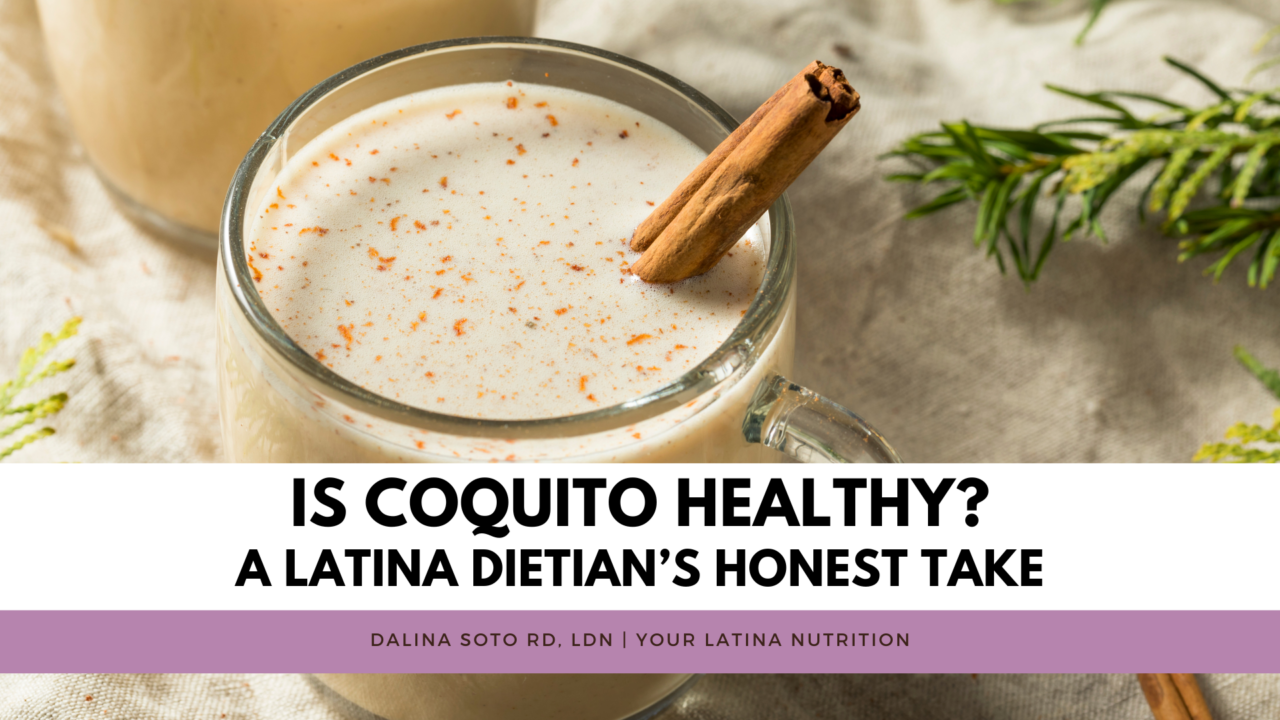
Coquito is a Puerto Rican coconut drink made for the holidays from coconut milk, cream of coconut, sweetened condensed milk, evaporated milk, rum, and warm spices like cinnamon, clove, and nutmeg. It’s chilled, served in small glasses, and bottled up to hand out to neighbors. Discover Puerto Rico describes the season as running from the day after Thanksgiving into mid-January, and coquito is at every gathering in between.
It gets called Puerto Rican eggnog in English, which is a little misleading, because traditional coquito has no eggs in it. There are versions made with eggs, but the body of the classic comes from coconut rather than custard.
There’s a piece of history here I love: cream of coconut, the ingredient that makes coquito taste like coquito, was developed by Don Ramón López Irizarry in a small lab in Puerto Rico, who was looking for an easier way to get the cream out of the coconut. The same ingredient became the base of the piña colada, so the thing in your coquito is a Puerto Rican invention twice over.
Every family guards their own version, and some add pistachio, guava, or Nutella now. The arguments about whose is best are part of the tradition.
What’s Actually in Coquito
Three ingredients are doing almost all of the nutritional work.
Cream of coconut is coconut cream blended with sugar. It’s the sweetest thing in the bottle and it’s also where most of the saturated fat comes from.
Sweetened condensed milk is milk with much of its water removed and sugar added, so it brings dairy protein and calcium along with a significant amount of sugar.
Coconut milk adds richness and more saturated fat, with very little sugar of its own.
Then there’s the rum, and spices that contribute flavor rather than calories. So what you have is sugar plus saturated fat plus alcohol, with a little protein and calcium along for the ride.
Here is a typical nutritional profile for 4 fl oz of coquito:
- Calories: 299
- Total Fat: 8.9g
- Saturated Fat: 6.1g
- Cholesterol: 67.5mg
- Sodium: 67.5mg
- Total Carbohydrates: 20.4g
- Sugars: 20g
- Protein: 5g
Keep in mind each recipe will vary in ingredients and portion sizes, and this profile is just an approximation.
The Part Nobody Mentions: Serving Size
Coquito is traditionally served in a small glass rather than a mug or a tumbler. Discover Puerto Rico compares the pour to almost a shot, sipped slowly, usually alongside pasteles or arroz con dulce or whatever else is on the table.
This matters more than any ingredient swap. The traditional way to drink coquito is already a small pour, and the nutrition numbers that circulate online are often calculated against a full cup, which is a serving on the heavier side, but hey, who am I to judge.
I bring it up because the traditional practice turns out to be the reasonable one, so there’s nothing here to modify beyond serving it the way it’s meant to be served.
How Coquito Affects Blood Sugar
Sugar in liquid form reaches your bloodstream faster than sugar in solid food, since there’s no fiber to slow it down and nothing to chew.
The fat in coquito does slow absorption somewhat, which is why a small glass with food is a gentler experience than the same amount of sugar in juice. But it’s still a sweet drink, and if you’re monitoring your blood sugar you’ll see it.
What softens the curve is eating food alongside it, which is exactly how coquito shows up anyway, at a table with everything else. The version that hits hardest is the one you drink standing in a kitchen having eaten nothing since lunch, which is the same principle I walk through with pan dulce and café con leche.
The Alcohol Question
This is the section I’d actually ask you to read, and it gets skipped in almost everything written about holiday drinking.
Alcohol can lower your blood sugar, and the risk lasts for hours after your last drink. Your liver normally releases stored glucose to keep your levels steady between meals, but when there’s alcohol to process, the liver prioritizes that job and the glucose release slows down.
For most people that passes without incident. If you take insulin or certain diabetes medications like sulfonylureas, it can mean low blood sugar overnight, after a drink that sent you higher earlier in the evening. The spike and the drop are two separate events, and the second one can come when you’re asleep.
What helps:
- Eat with it, and don’t drink on an empty stomach
- If you monitor, check before bed on a night you’ve had coquito
- Know that low blood sugar and being tipsy can feel very similar, which is what makes this worth being deliberate about
And this is where I want to be blunt, because it’s a diet-culture habit that’s also a real safety problem. Do not skip meals during the day to save room for a party.
That advice gets handed around every December like it’s common sense, and it isn’t. Arriving at a party underfed makes your blood sugar less stable, makes alcohol hit harder, and makes it more likely you’ll eat past comfortable and feel terrible about it, which is the whole all-or-nothing trap.
Eat normally that day, and then have your coquito.
If that pattern sounds familiar, this piece on the binge-restrict cycle explains the mechanics.
How to Enjoy Coquito
- Pour it the traditional way, in a small glass. It’s how it’s meant to be served and it’s the most effective thing on this list.
- Have it with food. Coquito next to pasteles is doing better by you than coquito on an empty stomach at eleven at night.
- Have water between glasses, which helps with everything.
- Make a virgin batch too. It’s the right answer for kids, and for anyone who’s pregnant, not drinking, or taking medication that doesn’t mix with alcohol. A lot of families make both anyway.
- Give some away. Bottling it for neighbors is part of the tradition, and it’s also how a batch this size is meant to be handled.
- Don’t try to make a “skinny” version, and I mean that. Coquito is supposed to taste like coquito, and a once-a-year drink made with substitutions you don’t enjoy is worse than a small glass of the real thing. If you’ve absorbed the idea that your family’s food needs fixing, these Latin American food myths are worth unlearning.
A Coquito Recipe to Try
Every family has its own coquito, and there’s no single right one. If you’re making your first batch, or you want to see how someone else’s kitchen does it, this is a video we love from Good Morning America.
Recipe and video: “How to make Puerto Rican coquito at home this holiday season,” Good Morning America.
Frequently Asked Questions
Can I drink coquito if I have diabetes?
Yes, with some planning. Coquito is sweet and alcoholic, so it can raise blood sugar and then lower it hours later. Have it with food, keep the serving traditional, and check before bed if you monitor. If you take insulin or a sulfonylurea, talk to your care team about what makes sense for you.
Does coquito have eggs in it?
Traditional coquito doesn’t. Some families make versions with egg, but the classic gets its texture from coconut.
How long does coquito last in the fridge?
In a sealed bottle in the fridge, coquito generally keeps about a week to 10 days, and less for some recipes, so check the one you’re using. Shake before pouring, since it separates.
Is coquito healthier than eggnog?
They’re comparable. Both are sweet, rich, dairy-heavy holiday drinks. Coquito’s fat comes mostly from coconut rather than cream and egg, but the sugar content is similar, and neither one needs to be justified.
Can I make coquito without alcohol?
Absolutely. Leave the rum out and you have the version kids drink at the same table.
Should I skip meals before a party where I’ll be drinking coquito?
No. Eating normally beforehand makes your blood sugar steadier, means the alcohol affects you less sharply, and makes it far more likely you’ll enjoy the evening and feel fine afterward.
Final Thoughts
Coquito is sweet and rich and it has rum in it. All of that is true and none of it is a reason to spend the holidays negotiating with yourself.
Pour it in a small glass, the way it’s served at home, and have it with food. Make a virgin batch for whoever isn’t drinking. And if you take insulin or a medication that affects your blood sugar, know that the alcohol matters more than the sugar and plan for that specifically.
Then drink it. It comes around once a year and it tastes like your family’s kitchen.
Want support that doesn’t disappear in December?
Our team of Latina registered dietitians works with your real life, holidays included, with no elimination lists and no eating rules you’ll abandon by January. We accept most major insurance plans.
See What Your Insurance Covers →
Sources
- “A Little Bit of History.” Coco López. cocolopez.com
- “How to Make Puerto Rican Coquito.” Discover Puerto Rico. discoverpuertorico.com
- “Authentic Puerto Rican Coquito.” Sense & Edibility. senseandedibility.com
- “Diabetes and Alcohol.” MedlinePlus, U.S. National Library of Medicine. medlineplus.gov
- “How to make Puerto Rican coquito at home this holiday season.” Good Morning America, YouTube. youtube.com